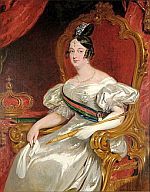
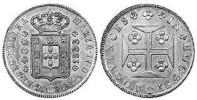
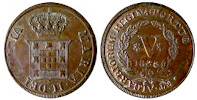
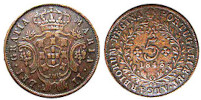
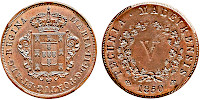
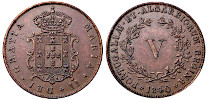
D. Maria II era filha do futuro Rei D. Pedro IV (Imperador do Brasil como D. Pedro I) e nasceu em 1819.
Em Março de 1826 o Rei D. João VI morria criando uma crise de sucessão em Portugal. O Rei tinha um herdeiro, D. Pedro, mas este tinha proclamado a independência do Brasil em 1822 e era então o Imperador daquele país. D. João tinha ainda um filho mais novo, D. Miguel, mas estava exilado na Áustria depois de liderar uma série de revoluções contra seu pai e seu regime liberal.
O Rei nomeou a sua filha favorita, D. Isabel Maria, como regente até que o legítimo herdeiro regressasse ao reino. Mas não especificou quem era o legítimo herdeiro, D. Pedro, o liberal Imperador do Brasil, ou D. Miguel, o exilado Príncipe absolutista?
A maioria das pessoas considerava que D. Pedro era o legítimo herdeiro, mas ninguém queria que ele unisse novamente Portugal e Brasil. O país europeu tinha estado sob o domínio brasileiro quando faziam parte do Reino Unido de Portugal, Brasil e Algarve, estabelecido por D. João VI durante a sua estadia no Rio de Janeiro de 1808 até 1820. Consciente de que os apoiantes de seu irmão estavam prontos a trazer D. Miguel de volta e colocá-lo no trono, D. Pedro decidiu por uma opção mais concensual, abdicou do trono a favor de sua filha mais velha, Maria da Glória (que tinha apenas 7 anos de idade), e ela deveria casar com seu tio D. Miguel, que deveria aceitar a Constituição Liberal e agir como regente até a sua sobrinha ser adulta.
D. Miguel fingiu aceitar, mas quando chegou a Portugal depôs D. Maria e proclamou-se Rei, abolindo a Constituição Liberal. Durante o seu reino de terror, D. Maria viajou por diversas cortes europeias, incluindo a de seu avô em Viena, e também Londres e Paris.
D. Pedro abdicou do trono brasileiro em 1831 a favor de seu filho (irmão mais novo de Maria) D. Pedro II, e da sua base nos Açores atacou D. Miguel forçando-o a abdicar em 1834. D. Maria retornou assim ao trono e obteve o anulamento de seu casamento.
Depois de engravidar constantemente, os médicos informaram D. Maria sobre o perigo de dar à luz quase anualmente. Ela ignorou o risco que também tinha morto sua mãe; “Se tiver que morrer, morro no meu posto” disse. D. Maria II morreu enquanto dava à luz o Príncipe Eugénio em 1853. D. Maria II é relembrada como uma boa mãe e tipo de pessoa que sempre actuava de acordo com as suas convicções no sentido de ajudar o país. Posteriomente foi-lhe dada a alcunha de “A Boa Mãe”.
O reinado de D. Maria II sofreu uma insurreição revolucionária em 16 de Maio de 1846, mas foi esmagada pelas tropas reais em 22 de Fevereiro de 1847, e Portugal evitava assim a sublevação europeia de 1848. O reinado de D. Maria II foi também notável pela actuação na saúde pública contendo o contágio de cólera pelo país. Ela também implementou políticas que ajudaram o aumento dos níveis de educação nacional.
D. Maria II (Mary) was the daughter of the future King Peter IV (Emperor of Brazil as Peter I) and was born in 1819.
In March 1826, King Joao VI died, creating a succession crisis in Portugal. The king had a male heir, Dom Pedro, but Pedro had proclaimed the independence of Brazil in 1822 and he was now Emperor Pedro I of that country. The late king also had a younger son, Miguel, but he was exiled in Austria after leading a number of revolutions against his father and his liberal regime.
The king had nominated his favourite daughter, Isabel Maria, as regent until ‘the legitimate heir returned to the Kingdom’. But he didn’t specify who was the legitimate heir. Pedro, the liberal Emperor of Brazil, or Miguel, the absolutist exiled prince?
Most people considered that Pedro was the legitimate heir, but nobody wanted him to unite Portugal and Brazil’s thrones again. The European country had been under Brazilian rule when both were part of The United Kingdom of Portugal, Brazil and Algarve, established by the King Joao VI during his stay in Rio de Janeiro from 1808 until 1820. Aware that his brother’s supporters were ready to bring Miguel back and put him in the throne, Pedro decided for a more consensual option: he abdicated the throne to his eldest daughter, Maria da Gloria (who was only 7 years old), and she should marry her uncle Miguel, who should accept the Liberal Constitution and act as a regent until his niece was an adult.
Miguel pretended to accept, but when he arrived in Portugal he deposed Maria and proclaimed himself King, abrogating the liberal constitution in the process. During his reign of terror, Maria travelled to many European courts, including her grandfather’s in Vienna, as well as to London and Paris.
Pedro abdicated the Brazilian throne in 1831 in favour of his son (and Maria’s younger brother, Pedro II), and from his base in the Azores he attacked Miguel, forcing him to abdicate in 1834. Maria was thereupon restored to the throne, and obtained an annulment of her marriage.
Maria’s reign saw a revolutionary insurrection on May 16, 1846, but this was crushed by royalist troops on February 22, 1847, and Portugal otherwise avoided the European upheavals of 1848. Maria’s reign was also notable for a public health act aimed at curbing the spread of cholera throughout the country. She also pursued policies aimed at increasing the levels of education throughout the country.
After constant pregnancies and births, doctors kept informing Maria of the danger of giving birth to nearly one child per year. She neglected the risks that had also killed her mother; ‘If I die, I die in my post’, she said. Maria II died while giving birth to Prince Eugene in 1853. (Her mother had also died of miscarriage.) Maria II is remembered as a good mother and a kind person, who always acted according to her convictions in an attempt to help her country. She was later given the surname “The Good Mother.”
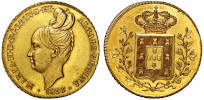
Os valores indicados abaixo são uma estimativa do preço de mercado, geralmente encontrada em guias de preços e catálogos de revendedores, e servem de referência para os colecionadores de moedas. Não representam nenhum preço de venda. Não vendemos moedas.
The values indicated below are a fair estimated market price usually listed in price guides and dealer catalogs to be used as reference for coin collectors. They do not represent any selling price. We do not sell coins.
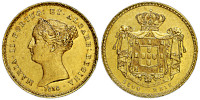
7 500 Réis - Peça
Ouro 31.50 mm Gold
Ano Year
Metal / Grau Metal / Grade
Cotação (€) Quotation (€)
1833
Ouro MBC Gold VF
4 000.00
1833
Ouro MBC Gold VF
3 500.00
1834
Ouro MBC Gold VF
1 200.00
1835
Ouro MBC Gold VF
1 200.00
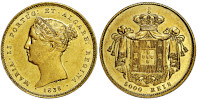
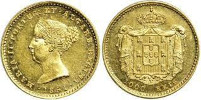
5 000 Réis - Coroa
Ouro 23.50 mm Gold
Ano Year
Metal / Grau Metal / Grade
Cotação (€) Quotation (€)
1838
Ouro MBC Gold VF
1 000.00
1845
rara rare
1851
Ouro MBC Gold VF
750.00
2 500 Réis - 1/2 Coroa
Ouro 19.50 mm Gold
Ano Year
Metal / Grau Metal / Grade
Cotação (€) Quotation (€)
1838
Ouro MBC Gold VF
800.00
1851
Ouro MBC Gold VF
390.00
1853
Ouro MBC Gold VF
1 200.00
1 000 Réis - 1/5 Coroa
Ouro 15 mm Gold
Ano Year
Metal / Grau Metal / Grade
Cotação (€) Quotation (€)
1851
Ouro MBC Gold VF
180.00
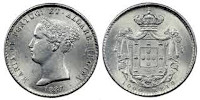
1 000 Réis - 10 Tostões
Prata 36.50 mm Silver
Ano Year
Metal / Grau Metal / Grade
Cotação (€) Quotation (€)
1837
Prata MBC Silver VF
400.00
1838
Prata MBC Silver VF
300.00
1842
rara rare
1844
Prata MBC Silver VF
240.00
1845
Prata MBC Silver VF
240.00
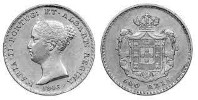
500 Réis - 5 Tostões
Prata 30 mm Silver
Ano Year
Metal / Grau Metal / Grade
Cotação (€) Quotation (€)
1837
Prata MBC Silver VF
1 000.00
1838
Prata MBC Silver VF
800.00
1839
Prata MBC Silver VF
900.00
1841
Prata MBC Silver VF
50.00
1842
Prata MBC Silver VF
50.00
1843
Prata MBC Silver VF
80.00
1844
Prata MBC Silver VF
100.00
1845
Prata MBC Silver VF
100.00
1846
Prata MBC Silver VF
40.00
1847
Prata MBC Silver VF
40.00
1848
Prata MBC Silver VF
100.00
1849
Prata MBC Silver VF
50.00
1850
Prata MBC Silver VF
100.00
1851
Prata MBC Silver VF
50.00
1853
Prata MBC Silver VF
370.00
480 Réis - Cruzado Novo
New Cruzado Prata 35 mm Silver
Ano Year
Metal / Grau Metal / Grade
Cotação (€) Quotation (€)
1833
Porto (Loios) Oporto (Loios)
rara rare
1833
Prata MBC Silver VF
90.00
1834
Prata MBC Silver VF
60.00
1835
Prata MBC Silver VF
50.00
1836
Prata MBC Silver VF
80.00
1837
Prata MBC Silver VF
1 500.00
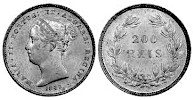
200 Réis - 2 Tostões
Prata 36.50 mm Silver
Ano Year
Metal / Grau Metal / Grade
Cotação (€) Quotation (€)
1836
bordo serrilhado milled rim
rara rare
1838
Prata MBC Silver VF
250.00
1841
Prata MBC Silver VF
300.00
1843
Prata MBC Silver VF
100.00
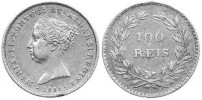
100 Réis - Tostão
Prata 19 mm Silver
Ano Year
Metal / Grau Metal / Grade
Cotação (€) Quotation (€)
1836
Prata MBC Silver VF
bordo serrilhado milled rim
2 750.00
1838
Prata MBC Silver VF
230.00
1843
Prata MBC Silver VF
100.00
1851
Prata MBC Silver VF
90.00
1853
Prata MBC Silver VF
40.00
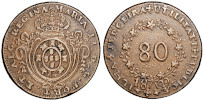
80 Réis - Maluco
Bronze 41 mm
Ano Year
Metal / Grau Metal / Grade
Cotação (€) Quotation (€)
1829
Bronze MBC Bronze VF
Angra
270.00
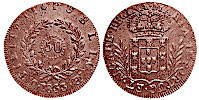
50 Réis
Cobre 36 mm Copper
Ano Year
Metal / Grau Metal / Grade
Cotação (€) Quotation (€)
1833
Açores Azores
rara rare
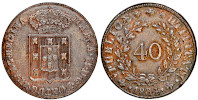
40 Réis - Pataco
Bronze 36.50mm
Ano Year
Metal / Grau Metal / Grade
Cotação (€) Quotation (€)
1833
Bronze MBC Bronze VF
Porto Oporto
280.00
1833
Bronze MBC Bronze VF
Porto (Loios) com legenda invertida Oporto (Loios) with inverted label